 |
| Tomoko on her recent seminar tour of Japan, 2013. |
Note: There is some misunderstanding on the Web regarding Makko Ho and its true origins. It has been attributed to Shizuto Masunaga, of Zen Shiatsu fame. This is incorrect. Authorship has also been claimed to be, "Mr. Makko," which is just plain silly. It has also been explained as six exercises instead of four.

All other iterations of "Makko ho" are simply misunderstood and mis-attributed. Please make a note of it.
Makko ho Japan: makkoho.or.jp
What is Makko ho?
Makko Ho is a stretching art and means, “look straight
forward.” This means, not just physically, but also mentally and spiritually –
be sincere and honest in what you’re doing, as well as having courage to face
life. Not looking back or to the side.
And Makko ho has a “Hombu
dojo” (main school) in Shibuya?
Yes, and there are many branch schools everywhere (in Japan).
And how many people
are training in Makko ho in Japan?
A lot. Tens of thousands.
 |
| "Ninjutsu: History and Tradition" |
The founder, Mr. Nagai. He owned a big company and was very
successful. He grew up in a Buddhist temple – his father was a monk. He didn’t
wish to follow his father’s path, he wanted to be in business, so he became a businessman and he was very successful. But he unexpectedly had a stroke (at 42 years old) and one
side of his body became paralyzed.
He could never imagine this happening to him. He had always
just focused on making money and he realized he had never taken good care of
his body or health. His doctor told him he could never return to work and would
have to stay in a bed the whole of his life.
His doctors gave up on
him?
Yes. They had no hope he would return to what he was. He
lost what he loved to do – make money. And he felt like he was nothing. He was
very lost. He wanted to give up on life.
 |
| Wataru Nagai 1869-1963 |
Right, he couldn’t go back to work. Then he had all this
time; time alone on his bed. So, he asked God, he prayed to God, and asked for
help, "I don’t know what to do." And then he remembered his father had given him
Buddhist sutras a long time ago. He thought it was the last hope. He opened the
book and read the sutras. In the sutras – it’s like a bible – he read the
words, ‘bowing deeply and showing your respect.’
Then he started thinking – I’m still alive. Maybe I never
felt the gratitude for my life. I survived. Maybe I go back to bowing and
showing my gratitude. He tried to bow on the bed and move his body and he was
so stiff. He couldn’t even bow to express his gratitude and he was so shocked.
He made a decision – he would do bowing movement and say “thank you” over and
over. He moved himself on the bed as best he could and kept it up. And two or
three years later he was cured.
So, he was mimicking
on the bed – he was imitating – the positions the monks knew to read the sutras
or recite the sutras? There are certain positions the monks had because they
sit for so long during meditations.
Yes, they bow in seated positions and also bow from standing
positions. It's like if you go to shrine, people bow. So it’s kind of showing
respect. Coming from long time ago. If you bow deeply, then you showing more
respect. So, people wanted to be flexible because they wanted to show more
respect to the god.
So, the deeper the bow, the more respect you’d be showing.
Yes. So, maybe starting from not exercise or being flexible.
People just wanted to bow to be close to the god or something higher.
 |
| Morning Makko ho. Bujinkan Shingitai-Ichi Dojo Gasshuku 2011. |

No, he wanted to save himself.
He wanted to express this new found sense of gratitude that he had for his own life.
Yes. So, that’s why Makko ho a little different from maybe
other exercises of stretching. It starts from his experience.
Seems like a similar situation with Yoga. You are also a certified Yoga instructor. And some people think Yoga is just stretching. But there’s this whole other side to it that most people will never see because they only know it occurring in fitness clubs as stretching routines. But you realize that there’s this whole other mental and spiritual side to it and Makko ho has this same ideal.
Yes – a positive attitude.
And eventually Nagai
sensei cured himself.
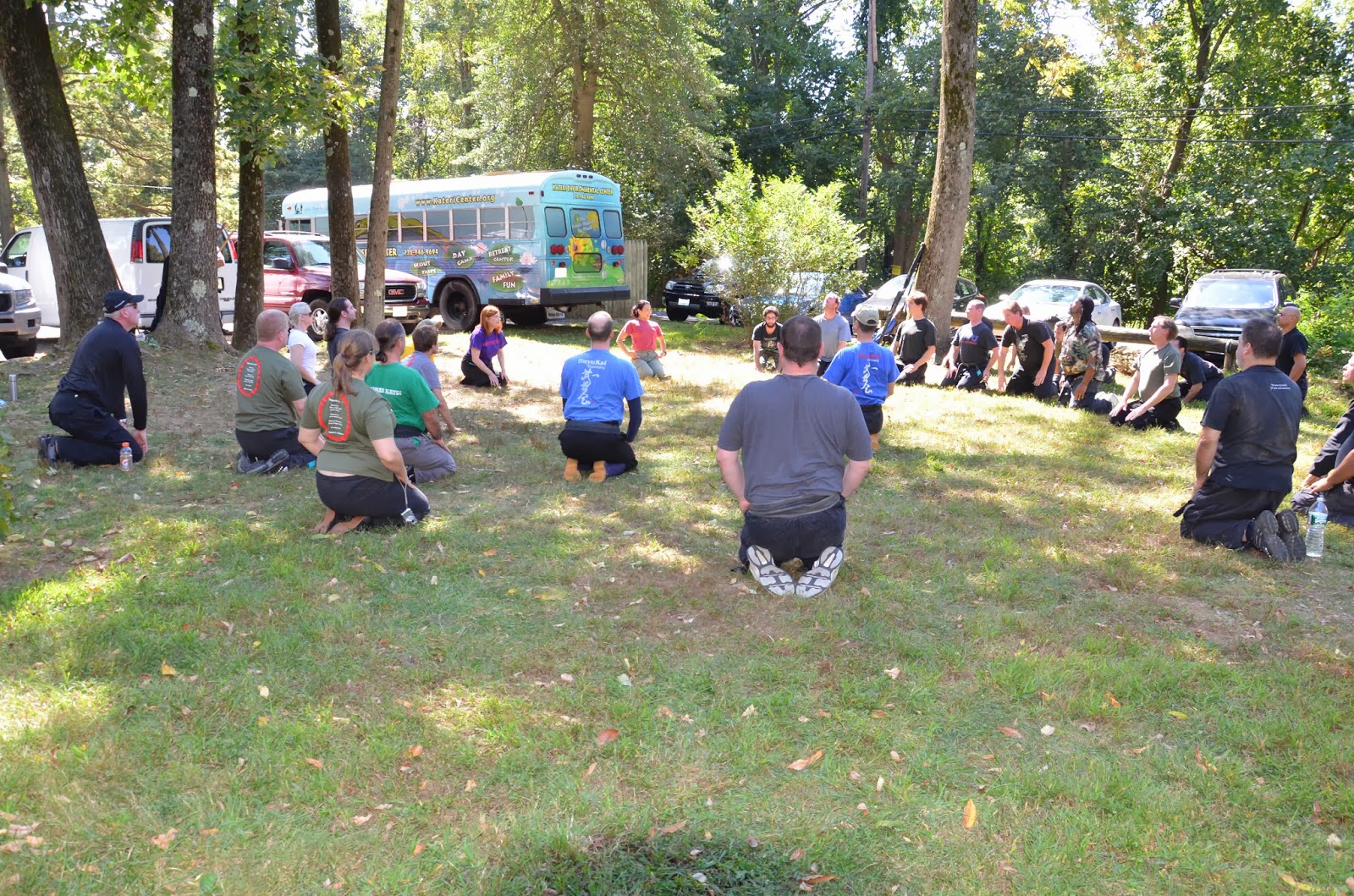 |
| Makko ho at Buyu Camp East, New Jersey, 2013. |
It was like a miracle! The doctor tried to figure out why he
was cured. Could be from bowing movement stimulate the “tanden” – your core. We
call it the center of the pelvis.
Is “hara” the same as “tanden?”
Hara is a more, bigger area. Tanden is a little below - a
couple inches - the belly button.
So, the movement is geared toward flexing this tanden.
Yes, and moving back and forth, kind of, rejuvenates the
circulation for your spine too. Because moving you sacrum back and forth helps
for the nervous system, so maybe that affects for ... the paralyzed.
 |
| Position 1 |
So, moving the body helped to move the blood and invigorate these deadened nerves?
If you do bowing movement, you need to breathe, otherwise
you cannot bow forward. You have to exhale, bow forward - otherwise it’s
difficult. So, the bowing movement maybe create more ... breathe deeper. And we call
“harakokyu.” That maybe help to get back more vital energy. But I think
most thing we think help to cure was he changed his attitude. His spirit
changed and everything was affected. Or could be the same time – the body,
mind, and spirit got together and brought him toward a cure.
 |
| Position 2 |
What are the basic movements of Makko ho?
There are four seated positions. And you can stretch all
sides of your legs with only these four positions. Outer, back, inner, and
front. Outer hip, IT Band on the side, the hamstrings and calves, inner thigh
adductor muscles, and the front quadriceps. Doing the bowing movement also
readjusts the pelvis naturally. Most of us, our pelvis is not even. Could be
one side is tighter than the other, then your pelvis always shifting one side
or the other or little bit tilt. Makko ho movement is all symmetrical and
‘evens up’ any imbalances because the movement exposes misalignment.
 |
| Position 3 |
The hinge.
Right. Or the “ogi,” Japanese fan, has a ‘kaname’ here.
That’s interesting. This past year, Soke was talking a lot about ‘kaname,’ the vital, or core points of Taijutsu.
 |
| Position 4 |
In terms of Makko ho,
the kaname is the kosshi.
Yes – the center. And it is connected with the tanden,
otherwise you cannot bend forward. So, when you bow, you are not rounding your
back and bowing – this is not bending from kaname. When you bow, you are bowing
from kaname, from your hip, so you have to learn how to move your pelvis. You
are not bowing from your middle back.
What are the four positions?
Position One is … If you are in Asia, people are used to sitting on the floor, and it is a very natural position for the seated position. Feet together and open your knees. If you see the baby sit on the floor, baby always sitting like that - knees out and feet closer. This is natural for them because their pelvis is so open. But when you get older the hip joint gets tighter and you cannot sit easy anymore. So, it is a more primitive seated position. Maybe our ancestors always sitting like that.
Position Two looks like an imitation of a standing bowing position (but seated). If you go to see the temples or shrines, people praying and bowing first - they are standing and bowing. The legs are together straight out in front of you.
The third position is for the weakest part of your legs. You open the legs out to the sides and bow forward. A side split position and stretches the inseam of your legs.
The last position is a backbend that stretches the front of the legs and body. You are seated in what is called, “wariza,” sitting between your feet.
I read somewhere wariza was a way to show an authority figure greater respect because it was to position yourself lower than them. Although, I am not certain that's true.
This is my guess: As a warrior, like samurai, you defend for the (master). And if you do "seiza" (a kneeling position) – in seiza you are ready to go fight. But in wariza, you can’t. Means maybe I am not fighting you. Or I have respect to be here. That’s my guess.
That would be an interesting history of that way of sitting. When samurai would go to see the emperor or be at a castle, they might have to wear very long hakama, because they knew it would make it harder to fight.
Right. They could not move.
The breathing – harakokyu – is the thing that connects all four. I think this is the most difficult thing people have with it. When I inhale that draws me down and when I exhale it presses me back up. Like how the lungs expand and collapse. An expansion and contraction with the movement. Also extension of the spine – I always tell people to rub their head on the ceiling. That expansion of the spine in order to get the extension right. There seems to be these other elements that activate the position.
Could be that breathing is more important than being flexible. How you breathe. Best breathing is longer and deeper and smoother. Slower. Feels like the diaphragm moving down, so more diaphragmatic breathing.
And that means making your belly big?
Yes, kind of expanding your stomach and then compress your internal organs.
See Part2


